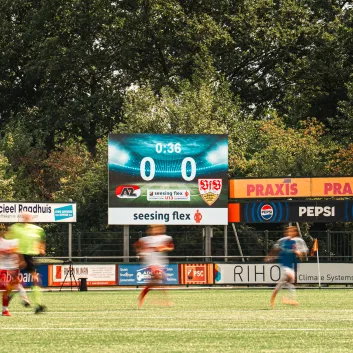
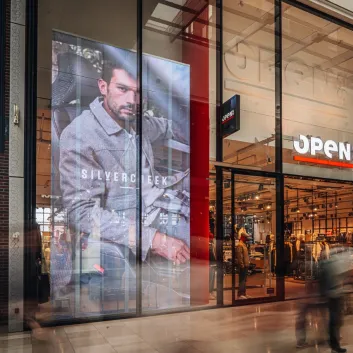
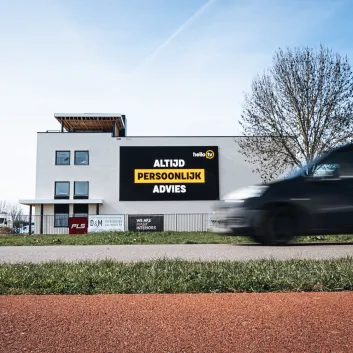
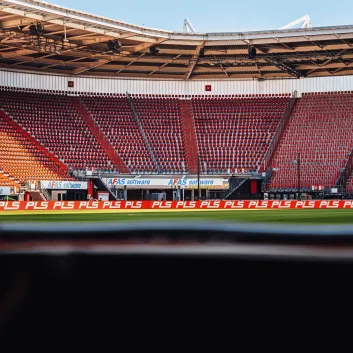



The biggest difference between an indoor and outdoor LED screen is brightness and weather resistance. An outdoor screen has a brightness of 5,000 to 10,000 nit to remain visible in full sunlight, and an IP65 rating or higher to withstand rain, dust and wind. An indoor screen needs only 800 to 2,000 nit and a lower IP rating. Choosing the wrong screen means it will be hard to see in the sun, or you’ll pay unnecessarily for a screen that stays indoors.
Brightness: the most noticeable difference
Brightness is measured in nit. The higher the number of nit, the more light the screen emits and the more visible it is in bright environments.
- Indoor screens: 800 to 2,000 nit. Enough for shops, offices, sports halls and trade fairs.
- Outdoor screens: 5,000 to 10,000 nit. Needed to remain easy to read in direct sunlight.
So placing an indoor screen outdoors is not an option. The image is barely visible during the day. An outdoor screen indoors, on the other hand, is technically possible but unnecessarily expensive and dazzlingly bright in an indoor space.
Many outdoor screens have a brightness sensor. It automatically adjusts the brightness to the ambient light. At night, they dim to a comfortable level; during the day, they switch to maximum brightness.
Weather resistance: IP rating
IP stands for Ingress Protection and indicates how well a screen is protected against dust and water. The two digits after IP indicate its resistance to dust and water.
- IP54: Splash-proof. Suitable for covered outdoor locations, such as a patio with a canopy.
- IP65: Completely dust-tight and resistant to water jets. Standard for outdoor screens.
- IP67: Resistant to immersion to a depth of 1 metre. For locations with extreme weather conditions.
- IP68: Completely waterproof. For the harshest environments.
For most outdoor applications in the Netherlands, IP65 is the standard. HOOQD outdoor screens come with IP65 as standard, with options for higher protection ratings for specific locations.
Pixel pitch: finer indoors, coarser outdoors
People stand closer to the screen indoors. This calls for a finer pixel pitch to produce a sharp image. Outdoors, people view the screen from further away, so a coarser and more affordable pixel pitch works perfectly well.
- Typical indoor: P1.5 to P4
- Typical outdoor: P6 to P16
Read more about pixel pitch in the article: What is pixel pitch and why does it matter?
Construction and housing
Outdoor screens have a more robust housing. They need to withstand thermal expansion and contraction caused by temperature fluctuations, moisture that causes condensation, and wind that exerts considerable force on large screens. The housing is thicker, the seals are better and the cooling system is more powerful.
Indoor screens are built to be lighter and more compact. This makes them easier to move and mount on lighter structures.
Power consumption and costs
Outdoor screens use more power than indoor screens because of their higher brightness and more powerful cooling. This is a factor to include in the total investment over the screen’s lifetime.
- Indoor screen: average of 200-500 watts per m2
- Outdoor screen: average of 500-1,000 watts per m2
Overview: indoor vs outdoor at a glance
Indoor
Outdoor
Brightness
800-2,000 nit
5,000-10,000 nit
Pixel pitch
P1.5-P4
P6-P16
Housing
Light and compact
Robust and weather-resistant
Price
Lower
Higher due to more demanding specifications
Power consumption
Lower
Higher
What if my screen is partly outdoors?
Some locations are partly outdoors: a covered patio, an entrance with a canopy, or a shop window facing directly south. In these cases, always choose a screen that is suitable for the most demanding conditions. Not sure? HOOQD will carry out a site analysis and advise you on the type that best suits your needs.
Want to know which type of LED screen is right for your location? Our specialists will assess your situation!